
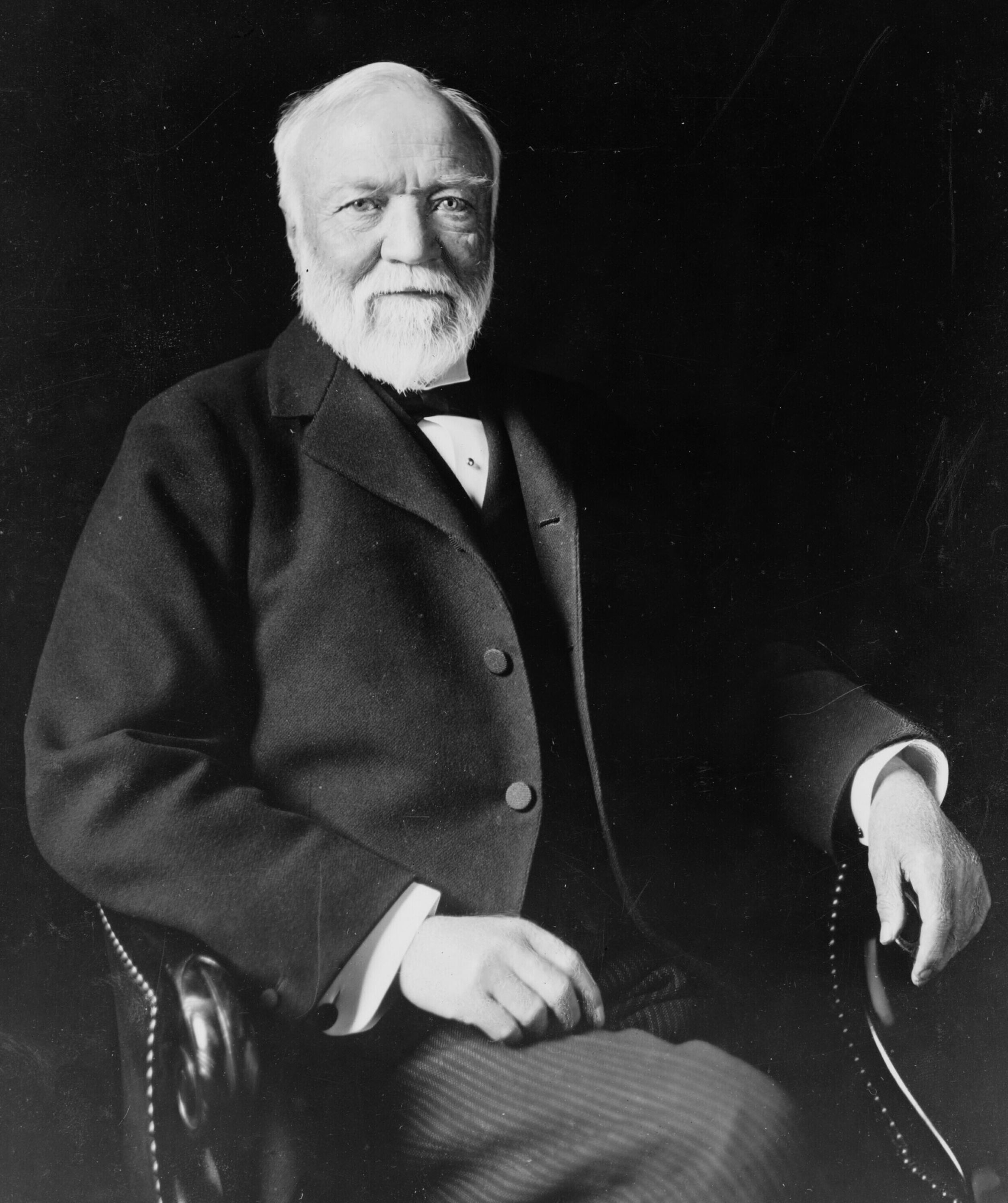
The name carved above the entrance to Ilkeston Library belongs to a man who rose from poverty to become one of the richest people in the world – and then devoted much of his fortune to giving other people the opportunity to learn.
Andrew Carnegie was born in Dunfermline, Scotland, in 1835.
His father was a handloom weaver, but the family struggled as industrialisation reduced the demand for traditional weaving. In 1848, when Carnegie was 12, they left Scotland and emigrated to the United States.
The young Carnegie had little formal education and began working long hours to help support his family.
One of the most important opportunities of his early life came from Colonel James Anderson, a retired businessman who allowed working boys to borrow books from his private collection.
Carnegie later recalled that he had been too poor to buy books himself and never forgot the enjoyment and education he received from those borrowed volumes.
The experience helped form a belief that would eventually leave its mark on Ilkeston and communities across the world.
From working boy to steel magnate
Carnegie progressed from working in a textile mill to becoming a telegraph messenger and operator. He later entered the railway industry before building an enormous business empire in iron and steel.
In 1901, he sold Carnegie Steel to financier JP Morgan for $480 million. The sale helped create US Steel and made Carnegie one of the wealthiest men in the world.
But Carnegie had already developed firm ideas about what wealthy people should do with their fortunes.
In his influential 1889 essay The Gospel of Wealth, he argued that the rich should regard themselves as trustees of their money and use it for the public good.
Its most famous declaration was: “The man who dies thus rich dies disgraced.”
Why libraries?
Carnegie believed that a free library gave people the means to educate and improve themselves.
His own organisation records that he and his foundation provided about $56 million to build 2,509 public libraries around the world. The first was established in his birthplace of Dunfermline.
Libraries carrying the Carnegie name were built across the United States, Britain and Ireland, Canada, Australia, New Zealand, South Africa, the Caribbean, Fiji and other parts of the world.
But Carnegie did not simply hand over money without conditions.
Under what became known as the “Carnegie formula”, a town generally had to demonstrate a need for a library, provide a suitable site and undertake to maintain, furnish and stock it as a public institution.
The intention was to create a permanent public service rather than merely an impressive building.
Carnegie’s gift to Ilkeston
A public library had been suggested for Ilkeston in 1879, but the project finally became possible when Carnegie offered £7,500 towards its construction.
Local figures, including former mayor Richard Hunt, were involved in securing the gift.
The building opened on 24 August 1904 and the words CARNEGIE FREE LIBRARY remain above its entrance today.
At the library’s opening in August 1904, Ilkeston Town Council decided to confer the Freedom of the Borough on Andrew Carnegie, the Duke of Rutland and Ilkeston MP Sir Walter Foster.
The library was opened by the Marquess of Granby on behalf of his father, the Duke of Rutland, who was unable to attend because of gout.
Carnegie did not attend the opening ceremony. His presentation was postponed until 13 May 1905, when he travelled from London to Ilkeston and was received at the Town Hall by the mayor, borough council and library committee.
During the visit, Carnegie was formally presented with the Freedom of the Borough in recognition of his gift to the town.
Carnegie’s £7,500 gift would represent a very substantial sum today, although historical comparisons vary depending on whether it is measured through prices, earnings or economic value.
An extraordinary legacy
Carnegie did not limit his philanthropy to libraries. His money supported universities, museums, scientific research, education, concert halls, peace initiatives and thousands of church organs.
Nevertheless, libraries became the most visible expression of his belief that knowledge should not be restricted to people who could afford it.
More than a century later, people in Ilkeston can still walk through the doors of the building his money helped provide.
The story of Carnegie is not simply the story of a millionaire giving money away. It is the story of a working boy who remembered what it meant to be given access to books – and used his fortune to extend that opportunity to millions of others. The Carnegie Corporation records his library legacy.
