
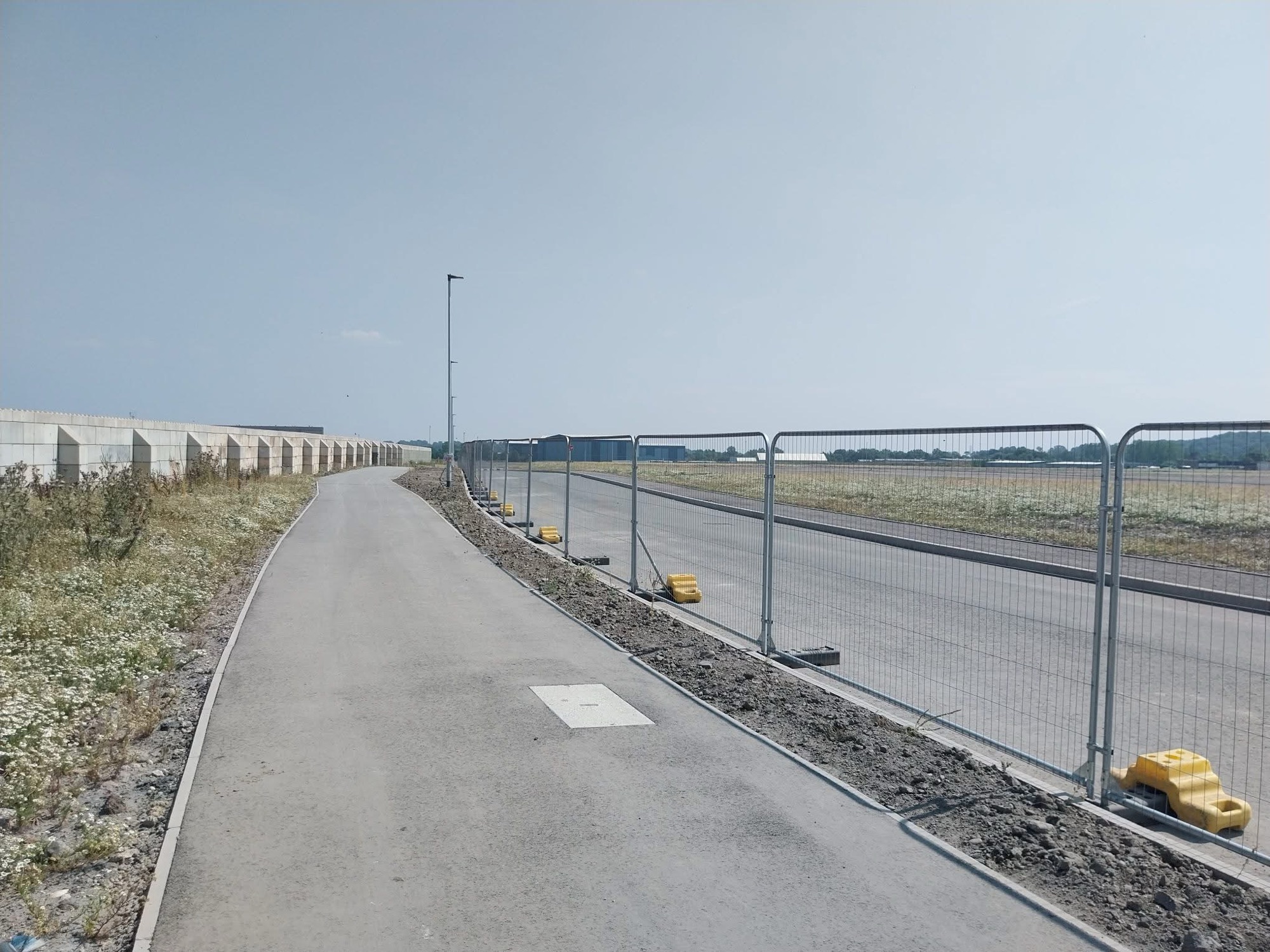
After more than a year behind barriers, National Cycle Route 67 through New Stanton Park has finally opened, restoring an important traffic-free link on the Nutbrook Trail.
For the walkers, runners and cyclists who have spent months following a diversion along Crompton Road and Hallam Fields Road, the reopening will come as a huge relief. Instead of sharing surrounding roads with cars, construction traffic and heavy goods vehicles serving the growing logistics park, users can once again follow the dedicated route through the former Stanton Ironworks site.
The reopening is undoubtedly good news, but it also brings renewed focus to a question campaigners have been asking for much of the past year: why was the route closed for so long?
A route that was meant to open much sooner
When plans for New Stanton Park were approved, the replacement section of National Cycle Route 67 was not simply an optional addition to the development. It formed part of the planning permission, with a condition requiring the diverted route to be completed and made available before the first building on the site was occupied.
That was intended to maintain a safe and continuous route for pedestrians and cyclists while the major regeneration scheme took shape.
In practice, warehouses were completed and businesses began operating while the new route remained closed. Users of the Nutbrook Trail were instead directed onto Crompton Road and Hallam Fields Road, where they had to mix with traffic serving the development.
For regular users, this was more than an inconvenience. A traffic-free route had been replaced by a diversion many considered less safe, despite the new path appearing to have been completed behind the barriers.
Residents started asking questions
As the closure continued, local residents and trail users began looking more closely at the planning documents. They examined committee reports, planning conditions and correspondence, comparing what had originally been promised with what had happened on the ground.
Local residents contacted Erewash Borough Council and continued raising concerns about the prolonged closure. Their persistence ensured the issue did not simply fade from view.
The matter eventually came before Erewash Borough Council’s Planning Committee after developer Verdant Regeneration applied for permission to install gates that would allow the route to open during the day but close overnight while construction continued elsewhere on the site.
Although the application related specifically to overnight closures, it gave residents the opportunity to raise the wider issue publicly and ask why the route had not already opened in line with the original planning condition.
Residents put their case to councillors
When the application was considered, residents arrived with detailed arguments based on months of research.
They accepted that a major construction site needed to be kept secure, but questioned whether closing part of the National Cycle Network was really the only solution. They pointed to the extensive fencing already in place around the development and argued that further fencing could have separated the public from construction activity while allowing the route to remain open.
Speakers also returned to the original planning condition. If the route was supposed to be available before the first building was occupied, they asked, why had businesses been allowed to move in while walkers and cyclists continued to be diverted onto surrounding roads?
The discussion quickly became about more than the proposed gates. It raised a wider question about the value of planning conditions if they are not delivered when promised.
Planning officers recommended approving Verdant’s application, arguing that daytime access would be an improvement on the complete closure and that shutting the path overnight would help balance public access with the needs of the construction site.
Councillors were not persuaded. During the debate, Councillor Prince said he was “fed up with being gaslighted” and questioned why other security options, including additional fencing, CCTV or patrols, had not been explored instead of restricting access to the route. Other members shared concerns about approving further restrictions on a path many believed should already have been open.
The committee ultimately refused Verdant’s application, concluding that the proposed overnight closures would “unduly restrict commuter and leisure cycling on this National Cycleway”.
A victory that still took time
The committee’s decision was an important moment for campaigners, but it did not lead to an immediate reopening. The barriers remained in place for several more weeks, leaving walkers and cyclists to continue using the diversion while they waited for something to change on the ground.
That is why the reopening feels like more than the removal of a set of barriers. It is the end of a long-running dispute that tested the patience of local residents and raised questions about how planning conditions are monitored and enforced on major developments.
It is also a reminder of what determined residents can achieve. Without the emails, objections, research and public representations made over many months, the route’s closure may not have received the same level of scrutiny.
New Stanton Park will continue to develop, bringing new businesses, employment and further construction to the former Stanton Ironworks site. The reopening of National Cycle Route 67 means walkers, cyclists and runners can now move through the area on the dedicated route they had been promised.
For campaigners, it is a welcome result and one they worked hard to secure.
But one question remains difficult to avoid: if the route was meant to be open before the first building was occupied, why did local people have to wait more than a year to use it?
One Comment
Welcome.
But teh bself-serving cynicism of the developer is a real concern.
As is the claim that this is a “permissive path”. Why is it not in the Planning Conditions that this be a Public Right of Way? AIUI that is the status of the one that was lost.