
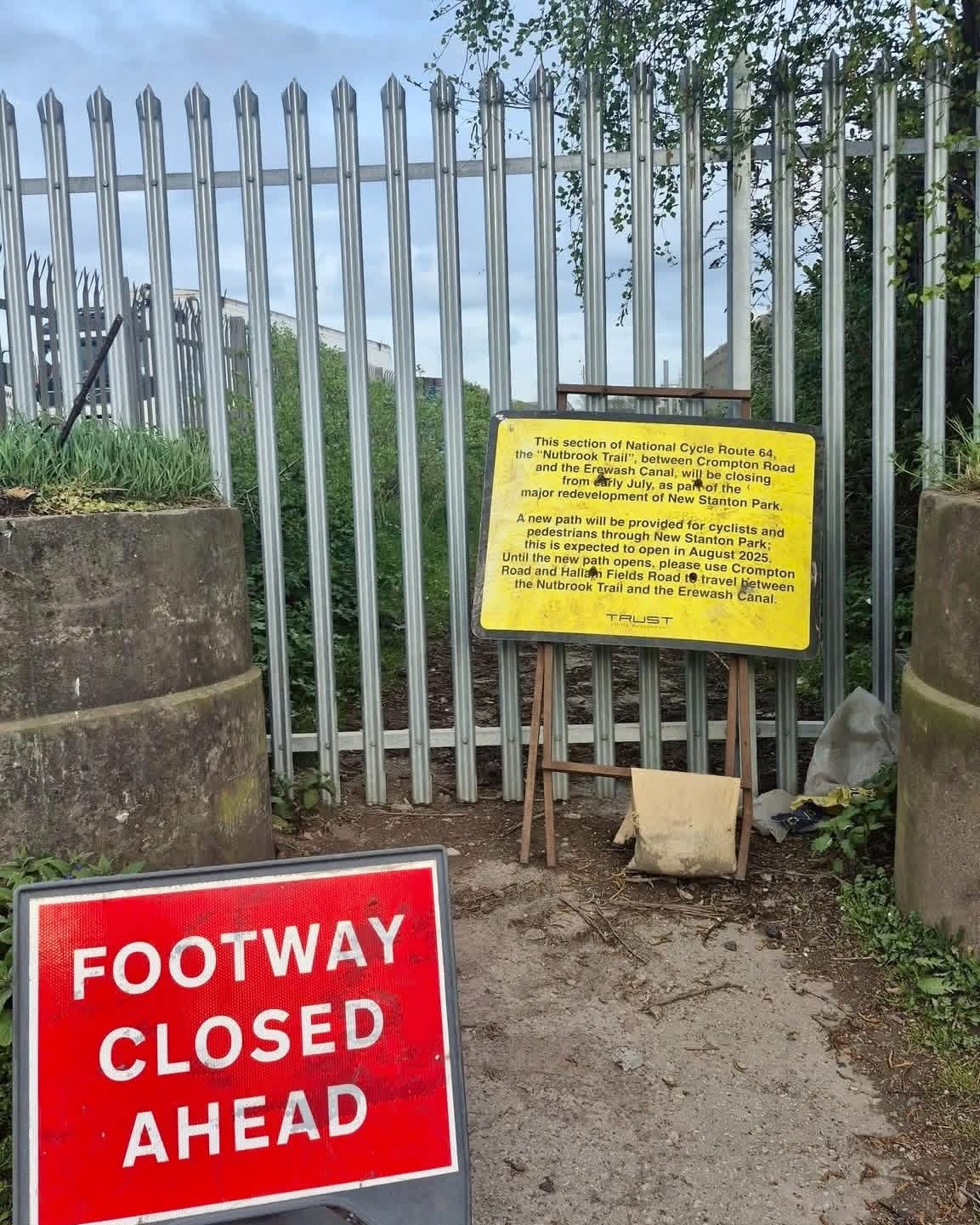
Plans to install gates and lock part of the Nutbrook Trail overnight have been thrown out by Erewash Borough Council’s Planning Committee.
In a decision welcomed by many local walkers and cyclists, councillors voted to refuse an application that would have allowed a newly diverted section of National Cycle Route 67 at New Stanton Park to be closed every night for up to three years.
The application, submitted by developers behind the New Stanton Park regeneration project, sought permission to install 2.4-metre-high security gates and fencing at either end of the new route. The proposal would have allowed the path to remain open during the day but be locked from 6pm to 7am.
The route forms part of the Nutbrook Trail and National Cycle Route 67, a key walking and cycling link connecting communities across the area.
During the meeting, objectors argued that the closure would set a dangerous precedent and effectively penalise the public for issues created by the development itself.
Residents and cycling campaigners told councillors that the original trail had already been closed for many months and that the official diversion forces walkers and cyclists onto roads used by heavy goods vehicles.
One speaker described the proposal as “a manufactured problem”, arguing that the developer could secure the construction site using fencing rather than locking users out of the cycle route.
Another objector warned that there appeared to be no other example of a National Cycle Network route in the UK being subject to daily timed closures and questioned whether Erewash should become the first authority to allow it.
The developer’s representative told the committee the new path would provide unrestricted access into parts of the wider construction site and argued that security and safety concerns made overnight closures necessary.
They said the route is a permissive path on private land rather than a public right of way and described the proposal as a pragmatic compromise that would allow the route to open during the day while protecting the active construction site at night.
However, several councillors were unconvinced.
Councillor Prince told the committee the developer had known for some time that the route should have been open under the original planning arrangements and said security concerns should be addressed by the developer rather than by restricting public access.
He argued that if additional fencing, CCTV or security patrols were needed, those measures should be funded by the developer rather than resulting in limitations on the public.
Other members highlighted the importance of the route for commuting, recreation and active travel.
Planning officers advised councillors that refusing the application would leave enforcement action as the likely route for seeking to secure the opening of the path.
After debate, councillors voted to refuse planning permission.
The decision means the proposed gates and overnight closures will not go ahead.
The outcome is likely to be welcomed by many local residents, walkers and cyclists who have campaigned for the route to be reopened and kept accessible around the clock.
Attention will now turn to when the diverted section of the Nutbrook Trail will finally open and what action may be taken to secure public access to the route.