 Skip to content

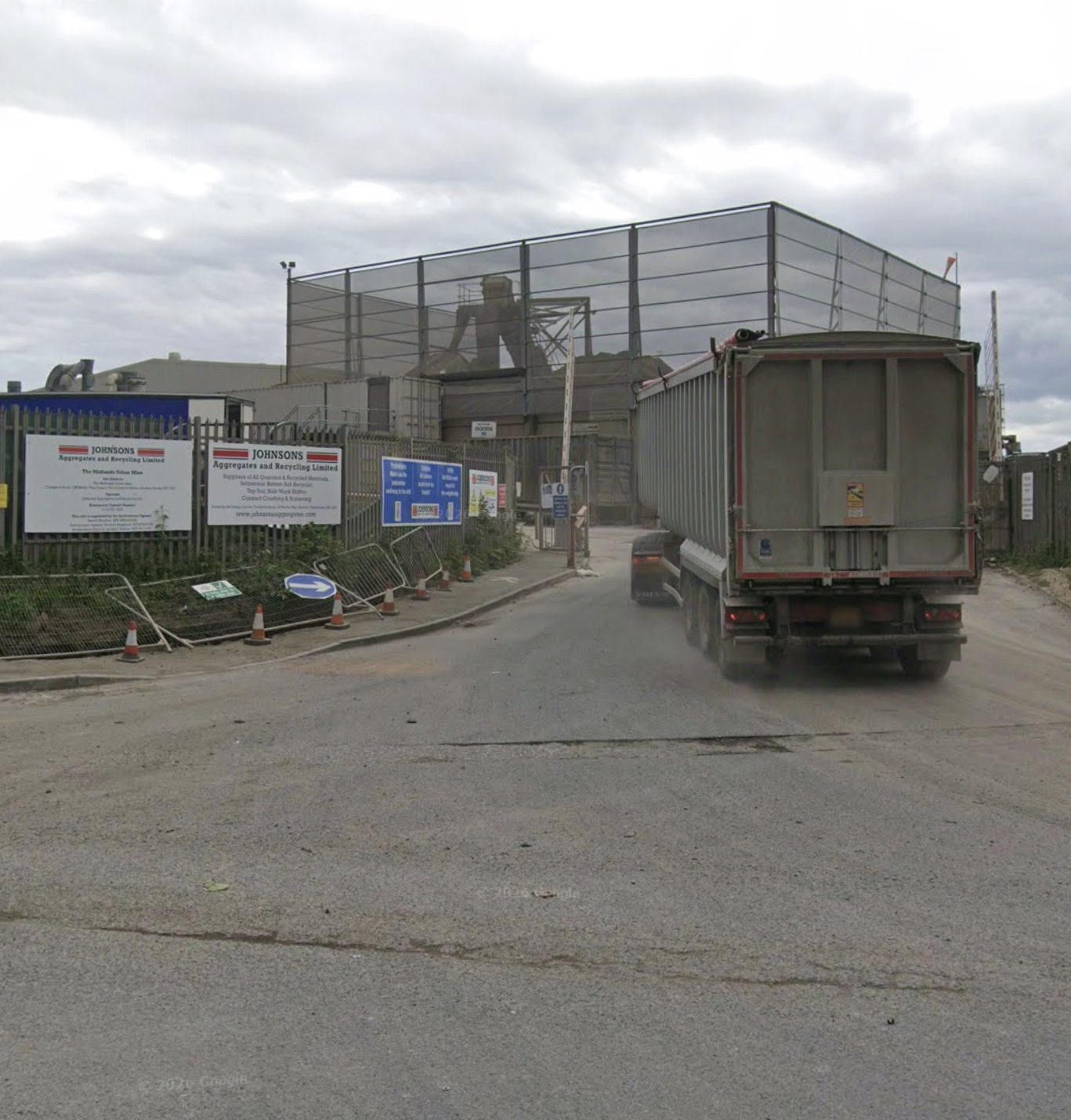
Plans to allow significantly more lorry movements at an Ilkeston recycling centre have been submitted to Derbyshire County Council, with supporting documents identifying potential increases in traffic and delays at nearby junctions.
Johnsons Aggregates and Recycling Ltd is seeking permission to increase the number of heavy goods vehicle movements allowed at its Crompton Road site, off Merlin Way, by nearly 50%.
The proposal would see the maximum number of HGV movements permitted each weekday rise from 272 to 400, while the allowance across weekends and bank holiday periods would also increase.
Although the company says the changes are necessary to make better use of its existing recycling capacity, the application raises questions about the impact of additional industrial traffic on roads around Quarry Hill, Lows Lane and Sandiacre.
Transport assessments submitted with the application identify increased lorry traffic on Crompton Road, additional delays at the Merlin Way junction and capacity pressures at several other junctions along the route towards the M1.
The company’s consultants nevertheless conclude that the overall impact would be limited and that the surrounding road network can accommodate the proposed increase.
What is changing?
Under its existing planning permission, Johnsons can have up to 272 two-way HGV movements each weekday, comprising 136 arrivals and 136 departures. The company wants to increase that limit to 400 movements, allowing up to 200 arrivals and 200 departures.
That represents an increase of 128 movements per weekday, or approximately 47%. The limit across a weekend period, including applicable bank and public holidays, would also increase from 132 to 194 movements.
A movement is counted each time an HGV enters or leaves the site. These figures represent maximum permitted movements, rather than the number of individual lorries necessarily using the site every day.
For context, a survey carried out on Wednesday 4 February 2026 recorded 256 HGV movements at the entrance to the recycling centre, below the existing weekday limit. The proposed new limit would allow 144 more movements than were recorded on that particular day.
Where would the extra lorries go?
The transport assessment indicates that approximately 80% of HGV traffic serving Johnsons heads south towards Junction 25 of the M1, while the remaining 20% travels north towards Junction 26.
All HGVs accessing the recycling centre use Crompton Road and Merlin Way before joining Quarry Hill Road.
The southern route passes through the Ilkeston Road, Lows Lane and Sandiacre area, with the assessment examining junctions including:
- Quarry Hill Road and Merlin Way
- Ilkeston Road, Sowbrook Lane and Lows Lane
- Lows Lane and Littlewell Lane
- Ilkeston Road and Stanton Gate
- Longmoor Lane, Town Street and Station Road
- Derby Road, Rushy Lane and Bostocks Lane
The Environmental Statement predicts that HGV movements on Crompton Road could increase by 52% between 9am and 10am, and by 49% between 1pm and 2pm, compared with the traffic levels used in the assessment.
The consultants acknowledge that the increase would be noticeable but consider the overall effect minor because Crompton Road serves an established industrial estate.
National Cycle Route 67 previously passed along this section of Crompton Road, close to the recycling centre. However, a replacement traffic-free route through New Stanton Park opened in July 2026, removing the need for cyclists to use that busy industrial junction.
What about congestion?
One of the more notable findings concerns the junction where Merlin Way meets Quarry Hill Road. Traffic modelling for 2031 predicts that additional HGV movements could increase delays for vehicles leaving Merlin Way by approximately 40 to 50 seconds during the morning rush hour.
The Environmental Statement identifies this as a minor to moderate adverse effect, although its overall conclusion is that the impact would be minor.
Further along the route, the assessments identify capacity pressures at the Longmoor Lane, Town Street and Station Road junction, as well as the Derby Road, Rushy Lane and Bostocks Lane junction.
Some of these junctions are predicted to operate above their theoretical capacity under modelled conditions even without the proposed Johnsons increase. However, the transport consultants argue that the additional HGV movements would have little noticeable effect on existing queues and delays.
The assessment also considers the junctions around Lows Lane and Sowbrook Lane, where future traffic growth has been an important consideration in discussions about the wider Stanton redevelopment.
Why does Johnsons want more lorries?
Johnsons operates an established recycling facility which processes incinerator bottom ash, the material left behind when waste is burned at energy-from-waste facilities.
The company recovers metals from the ash and processes the remaining material into recycled aggregate for use in construction.
In August 2025, Derbyshire County Council granted planning permission allowing the site to process up to 680,000 tonnes of material annually, increasing its previous permitted capacity of 350,000 tonnes.
However, Johnsons says the existing daily lorry limits prevent it from operating efficiently at that level. According to its planning statement, the restrictions limit the amount of material that can be transported into and out of the facility, leaving some of its permitted processing capacity underused.
The latest application does not seek to increase the annual 680,000-tonne limit. Instead, the company wants greater flexibility to accommodate busier periods, when more vehicles may be needed to deliver material or transport processed aggregate to customers.
The site would also retain its existing HGV operating hours, with deliveries and exports restricted to between 6am and 6pm and Sunday movements limited to imports of incinerator bottom ash.
Could this mean thousands more lorry journeys?
Potentially, although the distinction between permitted limits and actual traffic is important.
The Environmental Statement calculates that if the proposed maximum movements were used throughout the year, the theoretical annual allowance could rise from 75,408 to 110,888 two-way movements. That represents a difference of 35,480 movements annually.
However, these figures are not forecasts of how many additional lorry journeys will actually take place.
The company argues that because the annual tonnage limit is not increasing, actual yearly vehicle movements may remain similar, with the new limits simply allowing greater variation between busy and quieter days.
The application would nevertheless give Johnsons permission for substantially more HGV movements on individual days than are currently allowed.
What about noise and air pollution?
The application is accompanied by environmental assessments covering traffic, noise, air quality and other potential effects.
The submitted noise assessment predicts that additional HGV movements would increase noise levels at neighbouring noise-sensitive properties by no more than 0.1 decibels, a change considered too small to be perceptible.
The air-quality assessment also concludes that the proposed increase would not result in significant adverse effects on local air quality.
No changes to the recycling equipment, overall permitted processing capacity or HGV operating hours are proposed as part of the application. These findings form part of the evidence submitted on behalf of the company and will be considered by Derbyshire County Council before a decision is made.
The wider picture around Stanton
The application comes at a time when the former Stanton Ironworks site and surrounding industrial areas are undergoing further redevelopment.
While the Johnsons proposal concerns an established business rather than a new industrial facility, the cumulative impact of traffic from multiple developments is likely to be of interest to residents.
The transport assessment uses surveys from February 2026 and forecasts traffic conditions through to 2031. It applies general traffic growth allowances intended to account for development across the wider area, rather than adding separate traffic forecasts for every proposed scheme.
The question is whether those assumptions will adequately reflect future traffic levels as development around Stanton continues.
The assessment concludes that the additional Johnsons traffic can be accommodated without significant adverse effects, but the council will need to consider the evidence alongside any representations received.
How can residents have their say?
The application has been submitted to Derbyshire County Council, which is responsible for determining waste-related planning applications. It seeks to vary Condition 13 of the existing planning permission, which controls the maximum number of HGV movements at the recycling centre.
The application has not yet been approved.
Residents have until 20 December 2026 to submit comments, which can be made through Derbyshire County Council’s planning website or by emailing planningrepresentations@derbyshire.gov.uk.
The planning reference is CW8/1026/25. Anyone commenting must provide their name and full postal address.
For those who regularly travel along Quarry Hill Road, Ilkeston Road, Lows Lane or through Sandiacre, the proposals raise an important local question: how much more industrial traffic can the surrounding road network accommodate, particularly as further development takes place around Stanton?
Johnsons maintains that the increase is necessary for its operations and can be managed without significant environmental or highways impacts. The final decision will rest with Derbyshire County Council.
What do you think about the proposed increase in lorry movements? Are local roads capable of handling more HGV traffic? Share your views with Ilkeston News.