
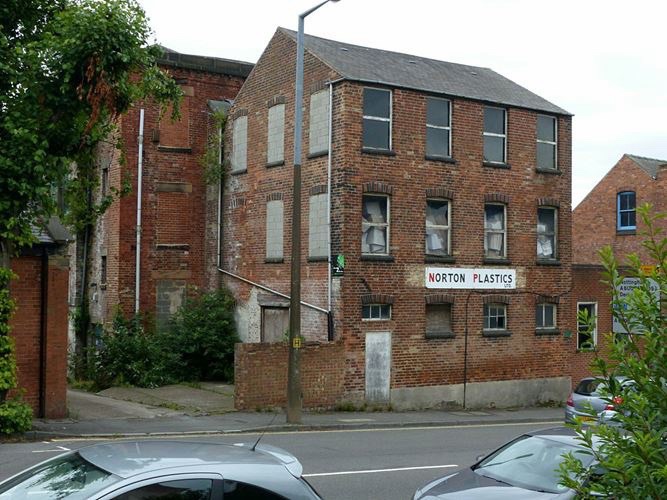
Plans to convert a former factory on Heanor Road into 23 apartments have been approved – but newly reviewed documents reveal the true condition of the building behind the decision.
Erewash Borough Council has granted permission to redevelop the former Norton Plastics site, a Grade II listed building also known locally as Bailey’s Factory.
The scheme will see the long-vacant industrial building turned into a mix of studio, one-bedroom and two-bedroom flats across four floors.
However, structural reports submitted as part of the application paint a stark picture of the building’s current state.
Severe structural deterioration
A detailed structural survey carried out in 2025 found significant damage throughout the building.
The report states that large sections of the roof have deteriorated beyond economic repair and will require complete replacement.
Internally, much of the structure has also been affected. Timber floors were found to be damaged or eroded, with some areas showing a reduced load-bearing capacity.
In several parts of the building, sections of flooring are missing entirely, while the main timber beams – which support the floors – have suffered deterioration caused by a combination of rot and possible fire damage.
Steel columns supporting the structure were also found to be bent and corroded in places, raising further concerns about the building’s condition prior to redevelopment.
The report also confirmed that an existing lift within the building is no longer usable and is beyond reasonable repair.
High-density layout approved
Despite the condition of the building, plans have been approved to create 23 flats within the structure.
These include a number of smaller studio apartments, some around 30–35 square metres in size, alongside one and two-bedroom units.
The development will span four floors, but no lift is proposed as part of the scheme.
No affordable housing provision
Planning documents also show that no affordable housing will be delivered as part of the development.
This is due to the application of “vacant building credit” – a national policy designed to encourage the redevelopment of previously used sites – alongside financial viability considerations linked to the cost of restoring the building.
No on-site parking
The approved plans do not include any car parking provision.
Instead, cycle storage is proposed, with a double-decker rack system providing space for bicycles.
Highways officers accepted the lack of parking due to the site’s town centre location, close to local amenities and public transport links.
Balancing heritage and development
The former factory is a prominent historic building in Ilkeston and has stood vacant for a number of years.
Planning officers concluded that bringing the building back into use would secure its long-term future, describing the proposal as one of the last viable opportunities to preserve the structure.
However, the scale of the structural issues – combined with the density of the proposed development and lack of affordable housing – may raise wider questions about the balance between regeneration and living standards.
What happens next
The development has been approved with conditions, meaning work cannot begin until further technical details are agreed.
If completed, the scheme will transform one of Ilkeston’s most recognisable industrial buildings into residential use – but only after extensive structural work to address the significant deterioration identified in the reports.
Ilkeston News will keep you updated.
🏭 The story behind Bailey’s Factory
Long before it became known as Norton Plastics, the building on Heanor Road was one of Ilkeston’s most ambitious industrial projects.
Originally built in the mid-1850s, it was developed by Bailey, Sons & Co., alongside local industrial figures including Joseph Taylor and Ezekiel James. At the time, it was a major lace and hosiery factory – part of a booming trade that helped drive Ilkeston’s growth during the Victorian era.
Constructed from red brick with distinctive stone detailing, the building was designed on a large scale for its time. Inside, steam-powered machinery supported production, and at its peak the factory employed hundreds of workers – making it a key part of the town’s industrial life.
But like much of the lace industry, its early success was short-lived.
By the 1860s, the trade had begun to decline, forcing closures and changes in ownership. The factory was later taken over by firms including Hill & Swanwick, as the building adapted to new uses in a changing economy.
Its history was not without incident. Records from the period describe a serious accident during redevelopment works in the 1860s, when a worker was badly injured following a collapse during construction activity – a reminder of the risks faced by those working in heavy industry at the time.
⚙️ A building that kept adapting
Over the decades, the site continued to evolve.
By the early 20th century, it had passed through several industrial uses, reflecting the wider shift away from traditional lace manufacturing.
During the Second World War, the building played a role in the war effort, producing protective clothing and equipment.
After the war, it entered a new phase as Norton Plastics, marking Ilkeston’s move into more modern manufacturing industries.
For many local residents, this is the version of the building they remember – a working factory rather than a historic landmark.
🏛️ From industrial powerhouse to derelict site
In 1986, the building was granted Grade II listed status, recognising both its architectural character and its importance to Ilkeston’s industrial heritage.
Despite this, the site has stood empty for many years – believed to have been vacant since around 2008.
Since then, it has fallen into significant disrepair, with parts of the structure now deteriorating and recent reports highlighting serious structural issues throughout.
Why its history still matters
From a Victorian lace factory to a plastics manufacturer, the building has spent nearly 170 years adapting to Ilkeston’s changing economy.
Today, it stands at another turning point – no longer just a reminder of the past, but part of an ongoing debate about how the town’s historic buildings should be used in the future.